
Home / The story of Diamond Lakes
In Pursuit of Dragon's Blood
The story of Diamond Lakes
Ninety-nine hectares on the Welverdiend–Grasfontein diamond run, first mined in the 1920s, surveyed by several of the most senior diamond geologists in southern Africa, and holding gravels that remain unworked.
The rush
The Lichtenburg fields sparked one of the great diamond rushes. Between 1922 and 1947 the Lichtenburg diamondiferous gravel runs produced 7,220,846 carats — enough to leave a permanent mark on South African mining history. The rush ran from the 1920s until the outbreak of the Second World War in 1939.
Source: E. H. Stettler, A Geological and Geophysical Investigation of the Diamond Runs on Ruigtelaagte and Vicinity, in the Bakerville Area, Lichtenburg District, Master's thesis, University of Pretoria, October 1979.
Diamond Lakes was then called Ruigtelaagte. It has changed hands many times. Mat Roux acquired it for Esroux Mining in the 1970s, having already taken on Elandsputte — a few kilometres away, later renamed Mat Roux and Sons Diamond Mining — in the 1960s. His sons Daan and Coen worked the sites with him through the 1990s. In the 1980s and 1990s the ground was also worked by Newmont SA, Transhex, Shenandoah Mining and others.
The surveys
Stettler's 1979 thesis is one of the most comprehensive geophysical surveys ever performed over this ground. It formed part of a larger Geological Survey investigation into whether gravel-filled sinkholes and channels could be located geophysically. Because only very selective areas of Diamond Lakes have been mined since, the survey remains broadly representative of the site today — an unusual thing to be able to say about a forty-year-old document.
Stettler later co-authored a paper with R. J. Kleywegt of the Council for Geoscience and Mike de Wit of Anglo American Research Laboratories, documenting much of the site's history alongside a limited drilling and sampling survey.
Source: Stettler, Kleywegt & de Wit, “Geophysical Prospecting for Diamonds in the Lichtenburg District, Western Transvaal”, Southern African Geophysical Review 1 (1995), 55–69.
The potholes
The bedrock under much of the mine is dolomite. Where it has eroded and collapsed it leaves pothole structures sitting directly in the path of the gravel runs, acting as gravity sink-traps for heavy material — diamonds, and in places manganese. Historically this has produced extraordinary recoveries.
Four dykes intersect on Diamond Lakes, with fracturing of the bedrock along a diagonal that runs through the midlines of the potholes: Pienaar's Pothole, S1, S2 and Gravitate. Pienaar's is the only one that has been mined below the water table. Gravitate has been mined down to it, and holds eight to fifteen metres of water depending on rainfall. S1 and S2 have had only their upper gravels touched.
Gravels have been located as deep as 80 metres below surface in places. Most of the mine's reserves lie below the water table, which is the reason the dredger exists.
The missing source
Diamonds form at depth and reach the surface through kimberlite pipes. Alluvial runs like this one are what remains after millions of years of weathering and movement by water or ice. Which raises the question that has occupied geologists here for a century: the kimberlite source for the Welverdiend–Grasfontein diamonds has never been found.
The intersecting dykes, the fault line, the kimberlitic material present in all four potholes, and the evidence that the diamonds have not travelled far, together point to a local source. That remains a hypothesis, not a finding. Establishing it would require a surveying and drilling programme that has not yet been carried out.
Dragon's blood
Pienaar's Pothole is one of very few places on earth documented to have produced a red-purple diamond. It was recovered by Stettler, Kleywegt and de Wit during their survey work — three geologists of international standing, which is a better provenance than most such stories carry.
Red and purple diamonds are among the rarest things the earth produces. They occur in quantities small enough that a producing mine may see one in a good year, and the mechanism behind the colour — a deformation of the crystal lattice — is still not fully understood.
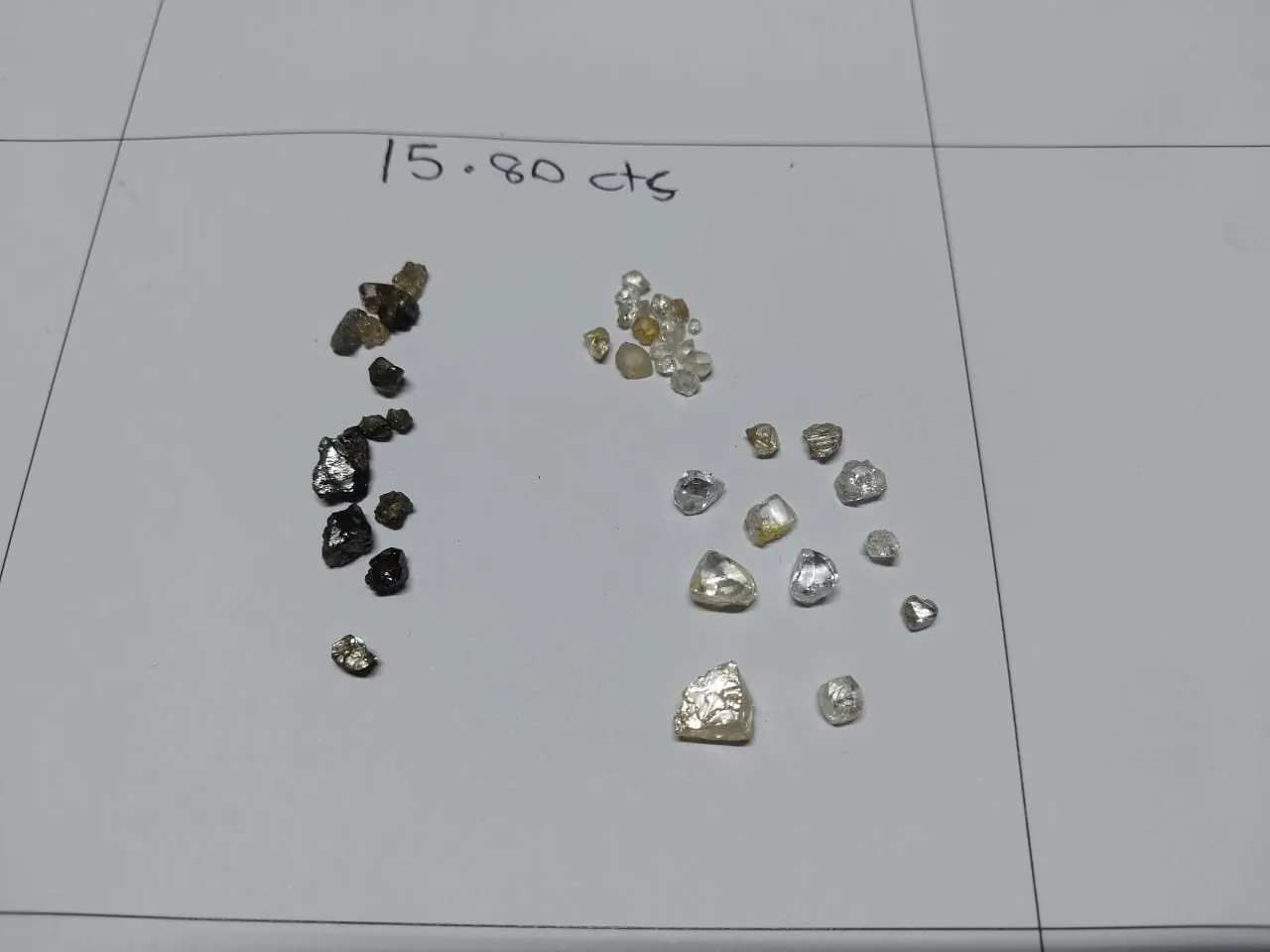
Two stones over 11 carats have been recorded from Diamond Lakes: one historically by Transhex, and an 11.2-carat stone during the 2018 bulk sample. The same sample produced a 4.2-carat D/E colour VVS rough stone and a number of small fancy-colour stones.
The 2018 bulk sample
A large bulk sample carried out in 2018 recovered approximately 3,500 carats. It came from easily accessible material only, and it confirmed much of what Stettler's report had predicted about the extent of the surface gravels.
The sample covered four areas: the superficial gravels of the S1 and S2 potholes, the tailings at Pienaar's Pothole, and virgin in-situ gravels to the east of Pienaar's. It did not extend to the Gravitate or Pienaar's potholes themselves.
Source: Diamond Lakes recovery records, 2018, as set out in In Pursuit of Dragon's Blood, Dr Navin Naidoo, 11 November 2019.
Why a dredger
At the end of the last century a moored platform working as an improvised dredger was used on the base of Pienaar's Pothole, with gravels processed on the shoreline. It had limited success — high clay content at the base, and pump systems that were not up to it. But it proved the principle: water-based extraction with onshore processing works here, and it cuts the energy cost of moving and processing gravel dramatically.
That is the lineage of the current dredger project. How it works.
What happens to the ground afterwards
Because recovery uses no leaching agents, no cyanide and no other destructive chemicals, the rehabilitation position is unusually good. The plan is four large independent bodies of water holding a clean, continuous supply for local fauna and flora — a self-sustaining wetland expected to draw migratory and resident bird populations and indigenous wildlife. The mine has previously worked with Working with Wetlands.
No chemical mining means that once rehabilitation is complete there should be little or no trace of the old workings. More on impact.
Further reading
Dr Navin Naidoo wrote about the project and about James Campbell, the technical adviser to Diamond Lakes, for The Diplomatic Society in October 2021 — describing Diamond Lakes as an alluvial deposit whose kimberlitic source “has not as yet been identified”.
Indiana James and the Legend of Diamond Lakes — Navin Naidoo, The Diplomatic Society, 7 October 2021.
About this account. It is drawn from In Pursuit of Dragon's Blood — The Story of Diamond Lakes, written by Dr Navin Naidoo and dated 11 November 2019, together with the published sources cited above. Figures are historical and carry the dates given. Nothing here is a forecast, a resource statement, or an estimate of future recovery. A competent person's report has not yet been produced for this ground.